Statcast deep dive on the Red Sox's three young left-handed starters — how Boston acquired Early, Tolle, and Bennett, what the pitch-level data says about each, and who is the most valuable dynasty asset long term.
The Red Sox rotation was supposed to be a story about Garrett Crochet this year. Instead, three left-handed starters age 25 or younger have combined for 39 starts, 219.2 innings, and a 3.16 ERA, and none of them cost the team a first-round pick. Connelly Early was a fifth rounder. Payton Tolle was a second rounder who signed for $2 million. Jake Bennett arrived in a December trade for a rehabbing reliever prospect that barely made the news.
If you play in a dynasty league, Tolle and Early have been on your radar since last year, while Bennett was only on the radar of deep dynasty league players. While each of them are lefty starting pitchers, they achieve their success (and have their own limitations) in very different ways, and the Statcast data separates them cleanly. Let's go through how each of them got here, what the pitch-level data actually says, and who you want to own for the next five years.
While you are here: our new StreamMachine ranks every probable starting pitcher for the week ahead by matchup quality, ballpark, opponent, platoon splits and workload, with a free Stream of the Day pick each morning that gets graded against the real box score. Weekly leaguers should also bookmark the Two-Start Pitchers page, which ranks every arm lined up for two starts in the same fantasy week. Both update hourly and both are free.
Go Pro — support FanRanked and browse the whole site ad-free.
Connelly Early is the win for org's development team. Boston took him in the fifth round of the 2023 draft, 151st overall, out of Virginia, where he tied the program's single-season record with 12 wins. Nothing about that pick suggested a fast mover. Two years later he was in Fenway striking out 11 Athletics over five innings in his September 9, 2025 debut, tying a Red Sox record for strikeouts in a debut that had stood since Don Aase in 1977. He finished his 2025 cameo with a 2.33 ERA and a 29-to-4 strikeout-to-walk ratio in 19.1 innings, then beat out Payton Tolle and Johan Oviedo for the fifth rotation spot out of camp this spring.
Payton Tolle is more of a natural talent it was hard to get wrong. He spent two seasons as a legitimate two-way player at Wichita State, transferred to TCU, gave up hitting, and immediately became the Big 12 Pitcher of the Year with 125 strikeouts in 81.1 innings. Boston took him 50th overall in 2024 and signed him for $2 million. He is listed at 6-foot-6, 250 pounds, and every inch of that frame shows up in the data (more on this below). His September 2025 debut went worse than Early's, with a 6.06 ERA and 5 home runs allowed in 16.1 innings, and the Red Sox started him at Triple-A Worcester this year. Rotation injuries ended that plan by late April.
Jake Bennett is one of the best finds by a scouting department in recent memory. Washington drafted him in the second round in 2022 out of Oklahoma, then lost him to Tommy John surgery in September 2023. He came back in 2025 and quietly posted a 2.27 ERA across 19 appearances at three minor league levels. On December 15, 2025, Boston sent right-hander Luis Perales, himself rehabbing from Tommy John, to Washington for Bennett straight up. It was Craig Breslow's first trade with new Nationals president Paul Toboni, who had just left the Red Sox front office and knew exactly what he was giving away (collusion?). Bennett got the call on May 1 when the rotation injuries kept coming, and he has been Boston's most efficient starter since.
Here is the 2026 season line for each, through July 9:
| Pitcher | Age | GS | IP | ERA | WHIP | K% | BB% | HR |
|---|---|---|---|---|---|---|---|---|
| Connelly Early | 24 | 17 | 91.2 | 3.44 | 1.25 | 23.8% | 8.5% | 15 |
| Payton Tolle | 23 | 14 | 80.1 | 3.14 | 1.07 | 25.2% | 6.8% | 8 |
| Jake Bennett | 25 | 8 | 47.2 | 2.64 | 0.94 | 18.5% | 3.9% | 3 |
Three sub-3.50 ERAs. Three completely different ways of getting there.
Surface stats lie about young pitchers all the time, so the pitch-level data is where this comparison gets decided. Everything below is 2026 Statcast data through July 9.
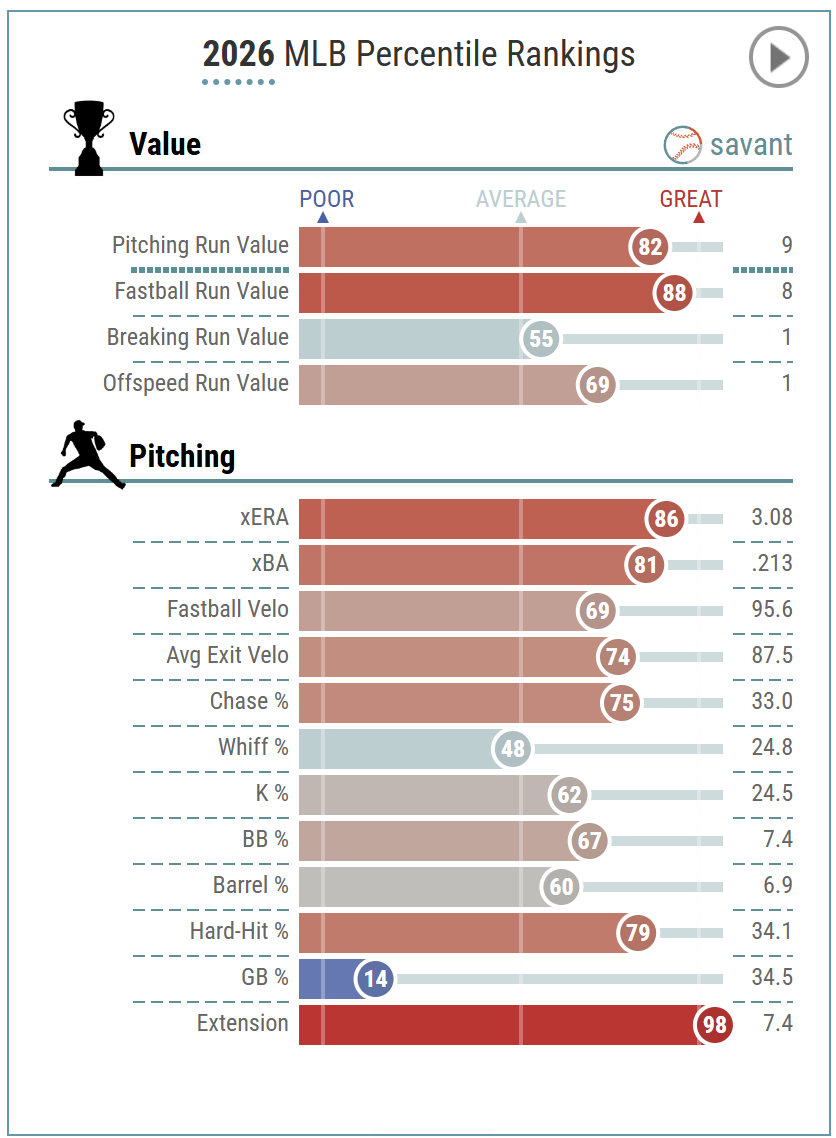
Tolle throws his four-seamer 96.1 mph on average, which by itself would be elite for a lefty. What makes it unfair is where he releases it. His average extension is 7.4 feet (thanks to his 6'6" frame), among the longest in baseball, which means hitters are reacting to something that behaves faster than 96. He rides that fastball at the top of the zone with 15.5 inches of induced vertical break and throws it 47 percent of the time, and hitters still manage only a .255 xwOBA against it.
| Pitch | Usage | Velo | Whiff% | xwOBA against |
|---|---|---|---|---|
| 4-Seam Fastball | 47.0% | 96.1 | 23.7% | .255 |
| Sinker | 21.8% | 95.0 | 10.1% | .351 |
| Cutter | 18.6% | 88.4 | 23.0% | .255 |
| Curveball | 8.8% | 82.4 | 44.8% | .196 |
| Changeup | 3.7% | 88.8 | 26.1% | .271 |
The number that should jump off that table is the curveball: a 44.8 percent whiff rate and a .196 xwOBA against, and he throws it less than 9 percent of the time. That is a putaway pitch he has barely started leaning on. His overall contact suppression is the best of the three by a wide margin: .273 xwOBA against, 32.9 percent hard-hit rate, 6.5 percent barrel rate, and an average exit velocity of 86.3 mph.
The one real flaw is batted-ball shape. Tolle gets ground balls on just 33.7 percent of contact, and a fly-ball lefty in Fenway is going to be susceptible to wall-ball doubles to right-handed hitters forever.
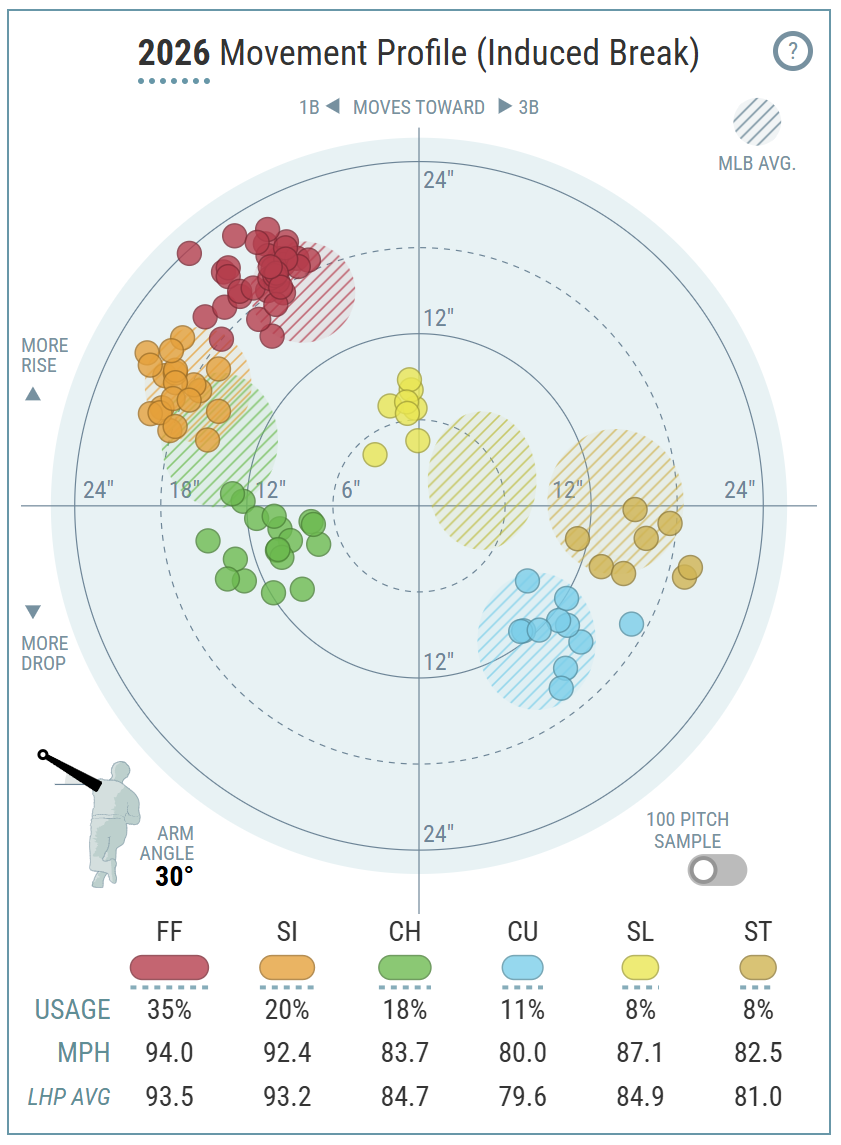
While Early doesn't have the raw stuff that Tolle has, he still has a solid repertoire that he utilizes effectively. He sits 94.1 with good ride on the four-seamer (16.0 inches of induced vertical break, which is genuinely excellent), and then he throws five other pitches around it. Six pitches with at least 100 thrown this season. Nobody else in this article, and almost nobody his age, runs an arsenal that wide.
| Pitch | Usage | Velo | Whiff% | xwOBA against |
|---|---|---|---|---|
| 4-Seam Fastball | 34.4% | 94.1 | 22.2% | .323 |
| Sinker | 19.0% | 92.5 | 13.0% | .368 |
| Changeup | 18.1% | 83.8 | 21.6% | .325 |
| Curveball | 10.9% | 80.2 | 26.2% | .394 |
| Slider | 9.8% | 87.1 | 25.8% | .255 |
| Sweeper | 7.8% | 82.5 | 41.3% | .115 |
Look at the bottom row. Early's sweeper has a 41.3 percent whiff rate and a .115 xwOBA against, and it is his sixth-most-used pitch. Combined with the slider (.255 xwOBA, 35.1 percent called-strike-plus-whiff rate), he owns two breaking balls that are already plus major league pitches. The problem is the middle of the table. The sinker and curveball are getting hit hard, and because he spreads his usage so evenly, more than 30 percent of his pitches this season have been below-average offerings.
That shows up in the contact quality. Early's 9.4 percent barrel rate and 40.8 percent hard-hit rate against are the worst of the three, and the 15 home runs in 91.2 innings are the ERA anchor. His .310 xwOBA against says the 3.44 ERA is roughly honest, and the fix is obvious enough that a pitching lab as good as Boston's will find it: throw the sweeper and slider more, bury the sinker. The strikeout foundation (23.8 percent, and 13.5 K/9 in last year's cameo) is real.
Now the elephant in the room: Early did go down with let elbow inflammation a couple of weeks ago. Chad Tracy came out and said that there wasn't anything wrong structurally, so I am hopeful he is able to come back in the second half and begin to control the HR issue from the first half.
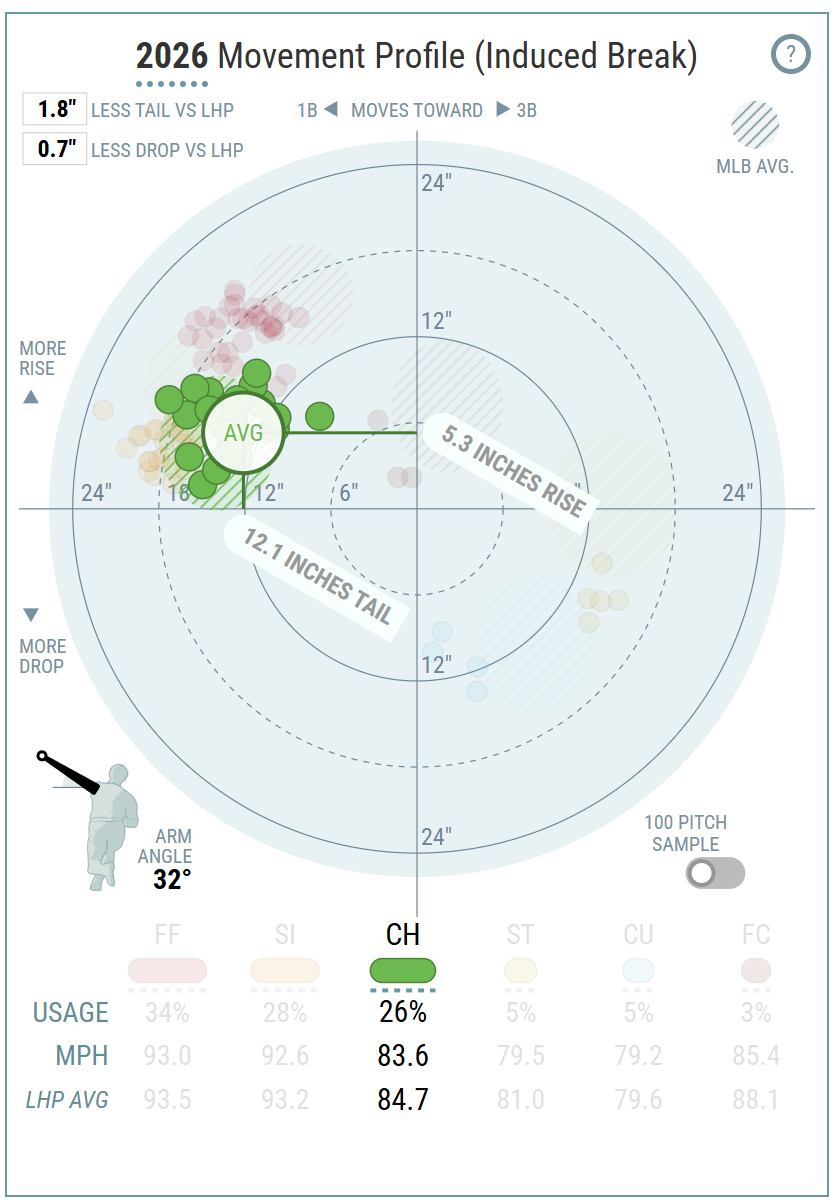
Bennett walks nobody. He is the Yin to Tolle's Yang. A 3.9 percent walk rate is elite for anyone, absurd for a guy eight starts into his big league career coming off Tommy John. He pounds the zone with a sinker-heavy mix, gets ground balls at a 49.4 percent clip (easily the best of the three), and kills at-bats with a changeup that is his one true wipeout pitch: .176 xwOBA against and a 30.8 percent whiff rate on 23 percent usage.
| Pitch | Usage | Velo | Whiff% | xwOBA against |
|---|---|---|---|---|
| 4-Seam Fastball | 35.5% | 93.3 | 23.8% | .331 |
| Sinker | 24.5% | 92.6 | 6.3% | .312 |
| Changeup | 23.2% | 83.7 | 30.8% | .176 |
| Sweeper | 6.1% | 79.8 | 19.0% | .289 |
| Cutter | 5.6% | 86.0 | 26.9% | .338 |
| Curveball | 4.6% | 79.3 | 7.1% | .405 |
The catch is the strikeout rate: 18.5 percent, a 6.6 K/9. The 2.64 ERA and 0.94 WHIP are being propped up by contact management (85.0 average exit velocity against, 5.8 percent barrel rate) and by never issuing a free baserunner, and his .291 xwOBA against suggests something closer to a mid-3.00s ERA is his true level. That is still a good major league starter. It is just a very different fantasy asset than the other two, because strikeouts are the currency of pitching in every scoring format, and Bennett does not print them.
However, I don't think Bennett is going to stick in the soft tossing lefty archetype. This is a guy who is currently in the 99th percentile of chase rate (38.7%) mainly off the back of his fantastic changeup, and that can mean more K's are in his future.
Ranking these three for the long term comes down to a simple framework: how much of the current performance is supported by the underlying data, how much growth is still plausible, and what the fantasy scoring categories actually pay for.
The bigger takeaway is about Boston. A 151st overall pick, a $2 million second rounder, and a change-of-scenery trade for a rehabbing arm produced three plausible long-term rotation pieces, all left-handed, all controllable into the 2030s. Who would have thought at the beginning of the season that the Red Sox would have a 3 headed hydra of young controllable left handed starting pitchers that didn't include Garret Crochet.
If you can only own one, own Tolle. If your window is right now, trade for Bennett before he turns the K's on and he takes the next step. And if you want a buy low future potential SP2 with an injury discount, Early could be a steal if he comes back in the 2nd half and begins to control his HR rate.
All data through July 9, 2026. Statcast data via Baseball Savant; xwOBA against computed per plate appearance from pitch-level data.